
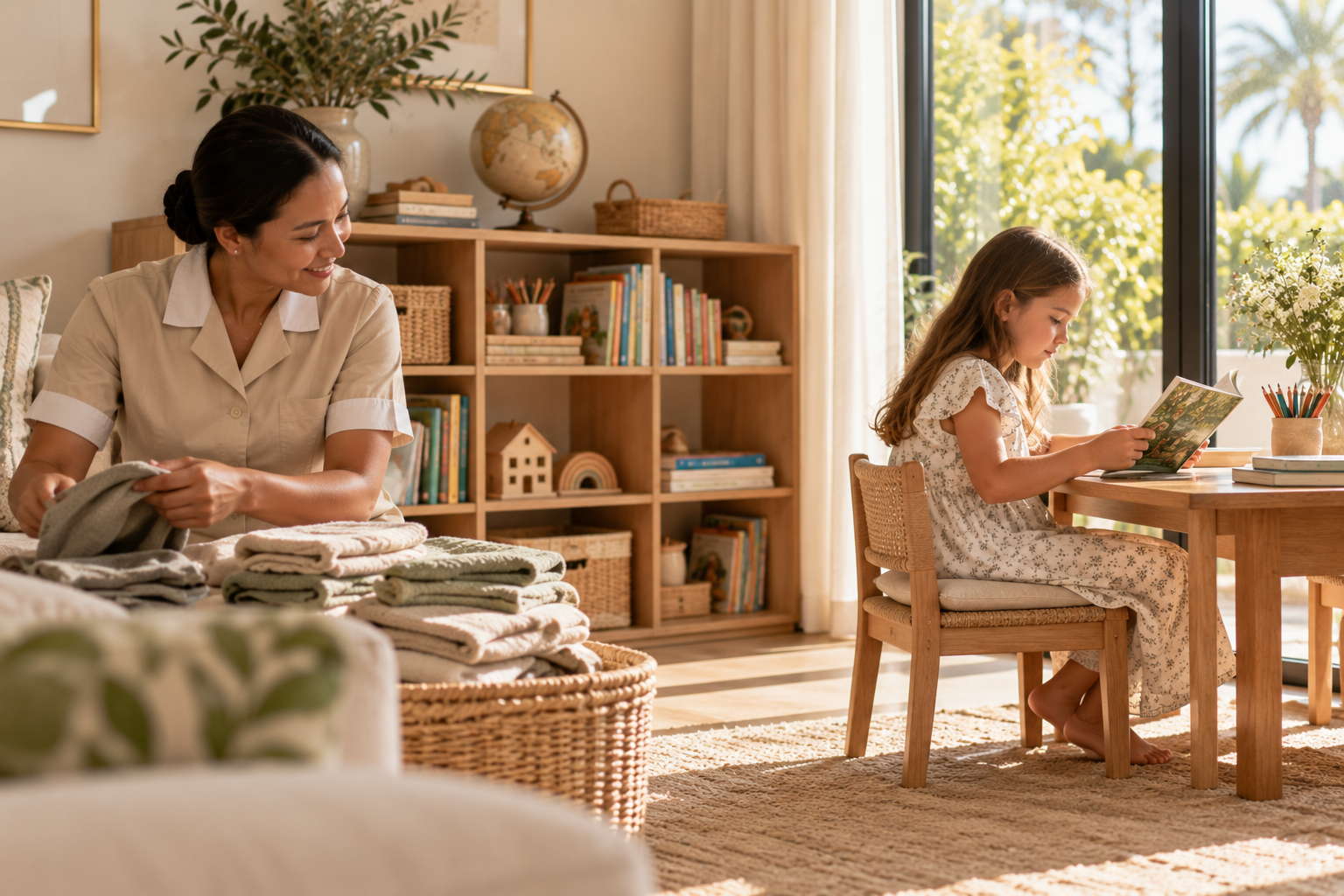
The hidden curriculum is everything a child learns without anyone teaching it: how adults react to mistakes, what a household treats as normal, who rushes and who waits. At home, it’s built from routines, conversations and expectations, and for learning at home in Dubai, as anywhere, it does more work than homework does.
It is 4.40pm on a Tuesday. A seven-year-old has a spelling list, her nanny is at the table beside her, and the pencil has gone missing for the second time.
Watch the next two minutes and you’ll learn very little about spelling. You’ll learn a great deal about the curriculum nobody wrote down. Does the adult fetch the pencil, sigh, or say ‘let’s find it together’? When the child writes becuase, does she hear a correction or a verdict? Is the point of the exercise to get it right, or to get better at it?
Same list. Same table. Same child. Two very different lessons.
Where the term comes from
Sociologists have talked about a ‘hidden curriculum’ since at least the late 1960s. Philip Jackson’s 1968 book Life in Classrooms described how school teaches things that appear on no timetable: waiting your turn, coping with being judged, working out what the teacher actually wants. Children absorbed all of it, and it shaped them as much as the official lessons did.
The idea has been applied to schools ever since. We think it applies at least as strongly to the home, where the lessons are daily, repeated, and delivered by the people a child trusts most.
The hidden curriculum of the home
It lives in four places.
- Conversations. A child who is asked ‘what do you think happened?’ learns that her thinking is wanted. A child who is only ever asked ‘have you finished?’ learns something else.
- Routines. The order of the evening teaches sequence, patience and what matters. ‘Bag, snack, ten minutes of reading’ tells a child the day has a shape she can rely on.
- Expectations. Children read expectations far more accurately than adults state them. If everyone in the house treats maths as a chore, a child will have a view on maths long before she meets fractions.
- The people around them. Most of this is delivered through behaviour rather than instruction: how the adults handle frustration, how they talk about school, what they do when they don’t know the answer.
Why it matters more than homework
Be fair to homework first. It isn’t useless, and the research doesn’t claim it is. But the evidence for young children is thinner than most parents assume.
John Hattie’s Visible Learning synthesis (2009) puts the average effect of homework at 0.29. Split that by age and it’s 0.15 for primary-age children against 0.64 at high school. Harris Cooper’s reviews point the same way: for secondary students, time spent on homework tracks with achievement, while for elementary students the relationship hovered around no relationship at all, in his words.
A few caveats are worth keeping in mind. These are averages across many studies. Correlation isn’t cause, and Cooper himself notes that struggling children often spend longer on homework simply because it’s harder for them. Primary homework is also set for other reasons: habit, routine, a window for parents into what’s being taught. None of that makes it harmful. It just means that if you’re hoping a worksheet will do the heavy lifting for a six-year-old, the research isn’t on your side.
Now put the hours next to each other. Call it 185 school days a year and seven hours a day. Against roughly thirteen waking hours across 365 days, school covers about 27% of a child’s waking life, even in a full academic year. That’s back-of-envelope arithmetic, not a study, so adjust it for your own school’s calendar. The point survives any adjustment: nearly three-quarters of a child’s waking life happens elsewhere. The car ride, the snack, bedtime, weekends, the long summer. That’s where most of the hidden curriculum is delivered.
One more finding is worth knowing. In their research synthesis on parent involvement in homework, Patall, Cooper and Robinson found that parents setting rules and routines was more strongly linked to achievement than other kinds of involvement, although the pattern shifted with the child’s age and subject. In other words, the structure around the homework mattered more than the adult’s help with the answers.
Learning at home in Dubai: a curriculum delivered by a team
Many Dubai households run on a team: parents, a nanny, a school, perhaps a driver, a tutor, a grandparent on a long visit. A child gets a curriculum from each adult, and the lesson that sticks is usually whichever one is delivered consistently.
If the nanny says ‘reading comes before screens’ and a parent, tired after a long day, says ‘oh, just let her watch something’, the child learns about rules (that they bend) long before she learns anything from the book. Inconsistency is a lesson too.
This is why we train nannies rather than only advising parents. In many households the nanny is the adult present for the most ordinary moments of a weekday: the car ride home, the snack, the meltdown over the pencil. Her habits are the hidden curriculum, whether or not anyone has examined them. Our Nanny Foundation Programme opens with emotional safety and behaviour for exactly that reason, before any conversation about academics.
None of this depends on whether your child is in a full-time school, a hybrid arrangement or learning mostly at home. The hidden curriculum travels with the child.
Four things you can change this week
- Sit through one homework session without stepping in. Notice what you do the moment she gets stuck.
- Swap one ‘have you finished?’ for ‘what was the hardest part?’
- Agree one routine that every adult in the house will follow, and hold it for two weeks.
- Say out loud what you do when you don’t know something. ‘I’m not sure. Let’s look it up’ is a powerful sentence.
Where homework fits
Keep it, but give it a smaller job. In the early primary years, short, calm and predictable beats long and thorough. Ten focused minutes with an adult who stays patient is worth more than forty minutes ending in tears.
As children grow, the balance shifts. Our Developmental Pathways treat homework as a skill built in stages: calm homework and school subjects at ages 5 to 7, being wrong safely at 7 to 10, going deep on something of their own at 10 to 12.